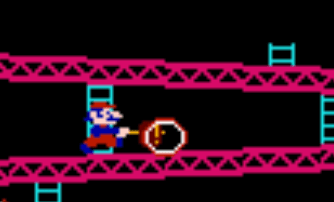
Donkey Kong is an ideal arcade game according to the parameters defined in Richard Rouse’s “Game Analysis: Centipede” piece. You play as Mario, traversing different linear platforms, avoiding the obstacles being thrown at you by Donkey Kong as you make your way to Princess Peach. Your controls are fairly limited here, and the game relies largely on your timing as a player. As a new gamer in general, this was definitely a challenge! After 30 minutes of play, I still wasn’t able to get past the first platform. The one “defense” you have against the onslaught of obstacles being tossed your way is a hammer. The first thing that stands out to me about this game is the infinite play feature. Rouse says that “having an unwinnable game makes every game a defeat for the player (463)” which felt apparent to me as someone new to the game, and arcade games in general. I have very little experience with games, but this was one of the more aggravating gaming experiences that I’ve had, due to this “unwinnable” nature that Rouse comments on. I think it’s very likely that the infinite play is more fun in a social environment like an arcade with a crowd of friends surrounding you. At home, losing over and over just makes you want to turn the game off. There’s an inherent dissatisfaction with the game experience. Knowing that there’s no real way to win makes the gaming experience sort of sadistically amusing, but only up to a point. Put simply: I found it fun, until I didn’t! It’s possible that the emulator might drag the playing experience down a bit, too. The game allows you to score points after clearing hurdles and avoiding certain obstacles, which Rouse references as one of the most important elements to a successful arcade game. You’re rewarded for getting better at the game, which does encourage the player to keep playing. Rouse argues that classic arcade games should have no story, which this game adheres to. Narratively speaking, it’s incredibly simplistic: advance up the platforms to beat Donkey Kong and win Princess Peach back from his clutches. The narrative never progresses beyond this basic set up, and never requires the gamer to engage with new elements of world building, or new characters. Players of the game might be bringing outside knowledge of the Nintendo universe, which could very well add to the narrative experience of the game, but none of that is baked into the gaming experience on its own in Donkey Kong.
Rouse, Richard, et al. Game Design: Theory and Practice. Wordware, 2005.
 Sadie's Play Journal